


February 10, 2026 | 5 min read
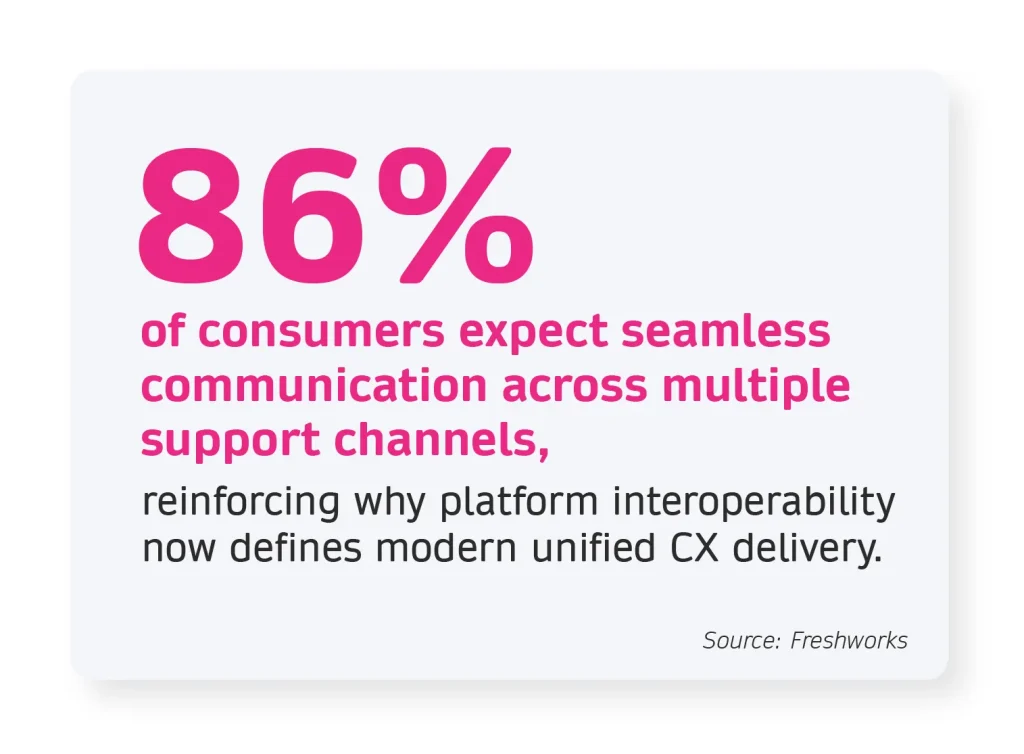
In 2026, interoperability defines how fast brands operationalize unified CX and deliver consistent value across every customer moment.
Why interoperability matters more than feature depth
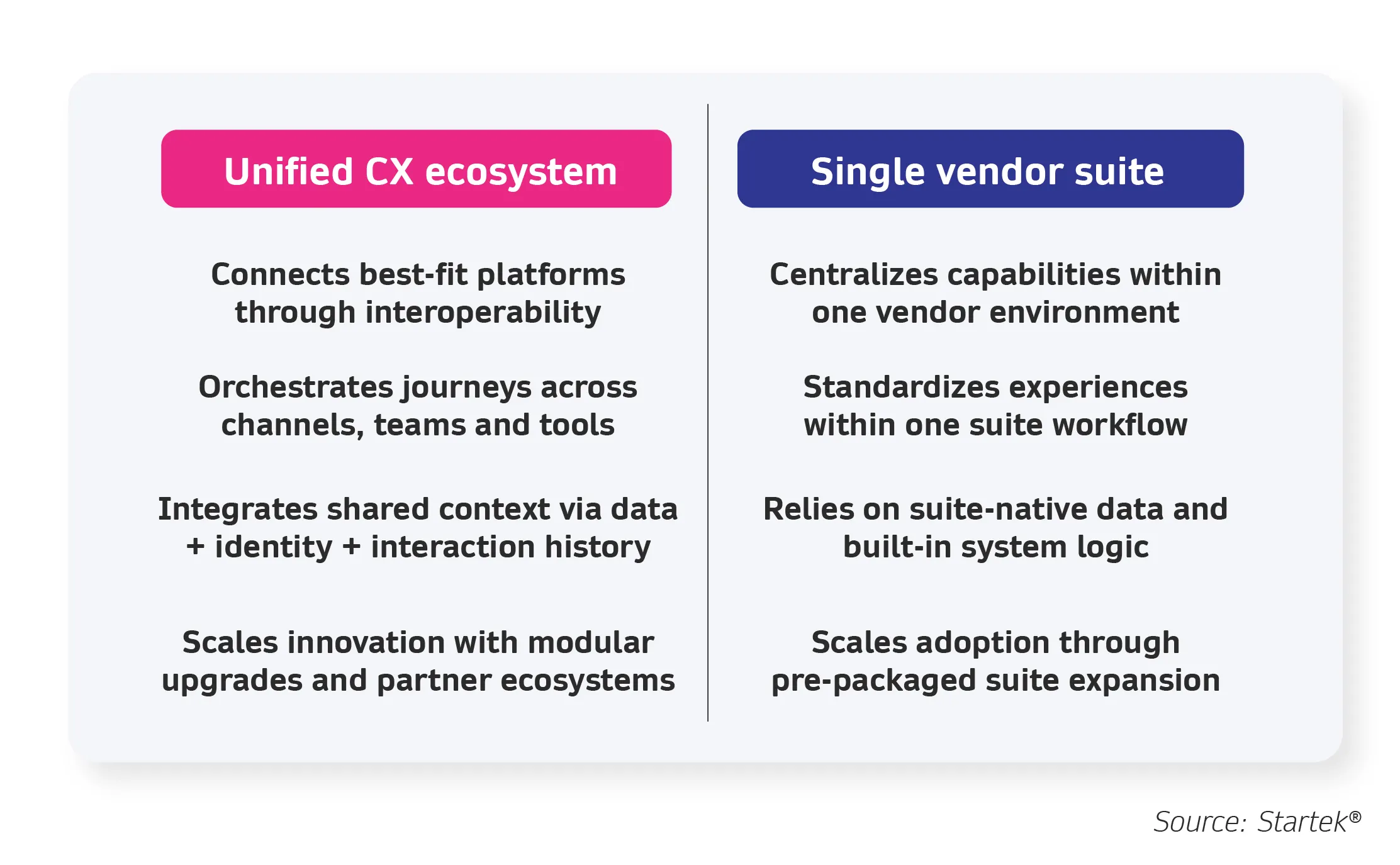
Feature-rich platforms create impact only when they work together across the customer journey. Interoperability enables teams to unify customer context, trigger the right workflows in real-time and carry intent seamlessly from self-service to assisted support. It strengthens decision-making by connecting data, knowledge and analytics across systems, helping unified CX solutions deliver a consistent, scalable and truly unified customer experience without friction between channels or functions.
Composable, API-driven CX architectures
Composable, API-driven architectures give enterprises the flexibility to build a CX ecosystem that evolves with business priorities. Instead of forcing every experience into a single platform, organizations connect best-fit capabilities such as CRM, CCaaS, WFM, analytics, automation and GenAI through shared APIs and orchestration layers. This approach accelerates innovation, simplifies integration and strengthens governance, making unified CX execution faster and more resilient while keeping the unified customer experience consistent across every touchpoint.
Traditional CX metrics like AHT and FCR measure speed and closure, yet they often miss the full customer journey when interactions move across tools, channels and teams. In a fragmented environment, performance data stays scattered, context resets at every handoff and leaders track outcomes in pieces instead of measuring experience end-to-end. Unified CX ecosystems change the metric model by connecting signals across the lifecycle, allowing unified CX solutions to track impact with greater clarity and deliver a truly unified customer experience at scale.
Unified ecosystems unlock journey-level visibility, which helps CX leaders measure what truly drives customer outcomes and operational value:
Resolution accuracy – Measures how consistently the right outcome gets delivered the first time, with complete context and correct actions.
Containment – Tracks how effectively self-service and automation resolve intent while keeping the journey seamless.
Cost per interaction – Captures the true cost across channels by linking effort, time and resources to each customer outcome.
Effective escalation – Measures how smoothly complex cases move to the right expert with full history and clear next steps.
Building unified CX takes more than connecting platforms. It requires a deliberate ecosystem strategy that scales with the business.
Tool-led thinking instead of ecosystem architecture
Teams invest in new CX platforms without designing the backbone that orchestrates journeys end-to-end.
Weak governance across data, journeys and decisioning
Organizations move fast on execution without clear ownership of standards, workflows and experience consistency.
Integration treated as a one-time setup
CX leaders connect systems once instead of building interoperability that evolves with every new channel, workflow and update.
AI scaled without unified context
Businesses expand automation before aligning customer history, intent and journey signals, reducing the impact of unified CX solutions on a unified customer experience.
CX leaders in 2026 will differentiate through execution by building the foundation for unified CX and scaling it with clarity and control.
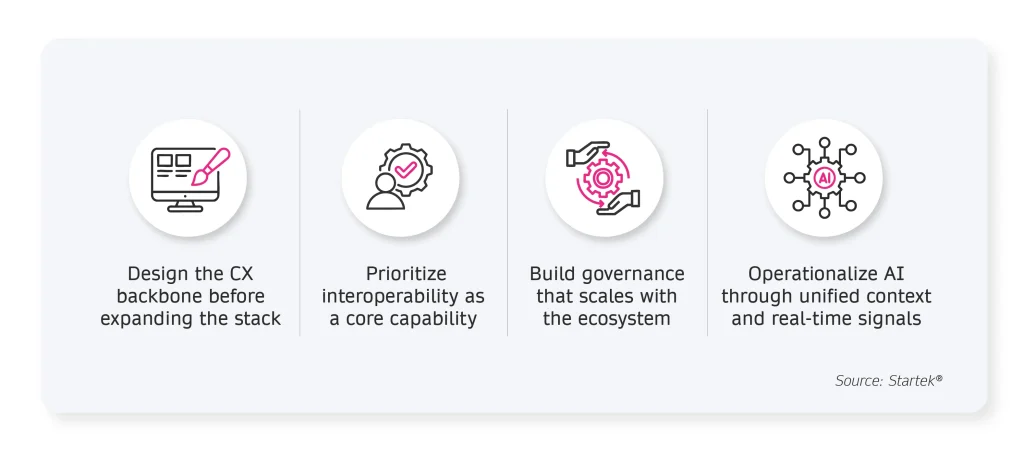
Design the CX backbone before expanding the stack
Create an orchestration layer that connects channels, customer context and workflows to deliver a consistent unified customer experience.
Prioritize interoperability as a core capability
Enable platforms to share data and trigger actions seamlessly so unified CX solutions work together across the full journey.
Build governance that scales with the ecosystem
Define ownership for journey design, knowledge, automation rules and data integrity to keep experiences consistent across teams and geographies.
Operationalize AI through unified context and real-time signals
Align customer history, intent and journey behavior so automation and agents act with precision across every interaction.
In 2026, CX leadership depends on building unified CX ecosystems that connect platforms, data and intelligence into one operating model. Unified CX solutions transform interoperability into measurable outcomes, enabling a truly unified customer experience at scale. This is where Startek stands apart – bringing deep CX expertise, platform-agnostic orchestration and execution rigor to unify journeys end to end. With Startek, enterprises move beyond integration to deliver CX that performs, adapts and leads.
Startek All Rights Reserved