


How to implement AI predictive personalization in your business

Startek Editorial

May 14, 2026 |  5  min read

Introduction

In today’s experience economy, AI predictive personalization has become a baseline expectation rather than a differentiator. Customers expect brands to anticipate their needs, deliver relevance in real time and create seamless journeys across every interaction. Organizations that embed predictive intelligence into their customer experience transformation strategies are seeing stronger engagement, higher conversions and more meaningful customer relationships. By combining workforce intelligence, digital employee enablement and an AI-augmented workforce, businesses move from reactive service to truly proactive CX – delivering the right experience at the right moment, every time.
A step-by-step approach helps translate AI predictive personalization into a practical, scalable implementation across your customer experience ecosystem.

Step 1 - Define your CX goals and use cases

AI predictive personalization starts with clarity. Define what you want to improve across your customer experience transformation journey – whether it’s increasing conversions, reducing churn and driving deeper engagement.

Focus on high-impact use cases

Prioritize specific, outcome-driven scenarios where predictive intelligence delivers immediate value:

Align with workforce readiness

Map each use case to the capabilities required across your AI-augmented workforce. Strong workforce intelligence and digital employee enablement ensure teams act on insights effectively and deliver consistent, proactive CX. Clear goals and focused use cases turn AI predictive personalization into a scalable, results-driven strategy.

Step 2 - Assess and prepare your customer data

AI predictive personalization is only as effective as the data behind it. Clean, connected and accessible data forms the foundation for accurate predictions and meaningful customer interactions.

Unify and clean your data

Break down silos across channels to create a single, consistent view of the customer. Ensure your data is accurate, up to date and structured to support real-time decision-making.

Build a strong data foundation for AI

Predictive models rely on rich, high-quality inputs. Focus on collecting and organizing:

Enable data access across teams

Data should not be placed in isolation. Equip your AI-augmented workforce with the right tools and digital employee enablement to access and act on insights in real time. Strong workforce intelligence ensures teams translate data into personalized, proactive CX. A well-prepared data ecosystem ensures AI delivers relevance, accuracy and impact.

Step 3 - Choose predictive models and tools

Selecting the right models and tools is critical to turning data into actionable personalization. Choose AI solutions that align with your use cases; whether it’s propensity modeling, next-best-action engines and real-time recommendation systems. Ensure they integrate seamlessly with your existing CX ecosystem. The focus should be on scalability, speed and ease of deployment, enabling your AI-augmented workforce to act on insights without friction. Leveraging platforms that strengthen workforce intelligence and support digital employee enablement are equally important for teams to interpret predictions, make informed decisions and deliver consistent, proactive customer experiences.

Step 4 - Activate personalized experiences across channels

With the right models in place, the focus shifts to activation, delivering personalized experiences consistently across every customer touchpoint. Use AI to orchestrate real-time interactions across digital, voice and assisted channels, ensuring each engagement reflects the customer’s context, intent and history. Seamless integration across platforms allows businesses to move from isolated interactions to connected journeys, where personalization is continuous. Empowering your AI-augmented workforce with the right insights through strong digital employee enablement ensures that both automated systems and human agents deliver relevant, timely and proactive experiences, driving engagement and conversions.

Step 5 - Measure impact and optimize continuously

Sustaining AI predictive personalization requires continuous measurement, learning and refinement.

Track the right CX metrics

Focus on KPIs such as engagement rates, conversion uplift, customer lifetime value and churn reduction to measure real impact.

Leverage workforce intelligence for insights

Use workforce intelligence to understand how effectively your AI-augmented workforce is using insights to deliver personalized experiences.

Continuously test and refine

Regularly optimize models, journeys and interactions to improve accuracy, relevance and overall CX outcomes over time.
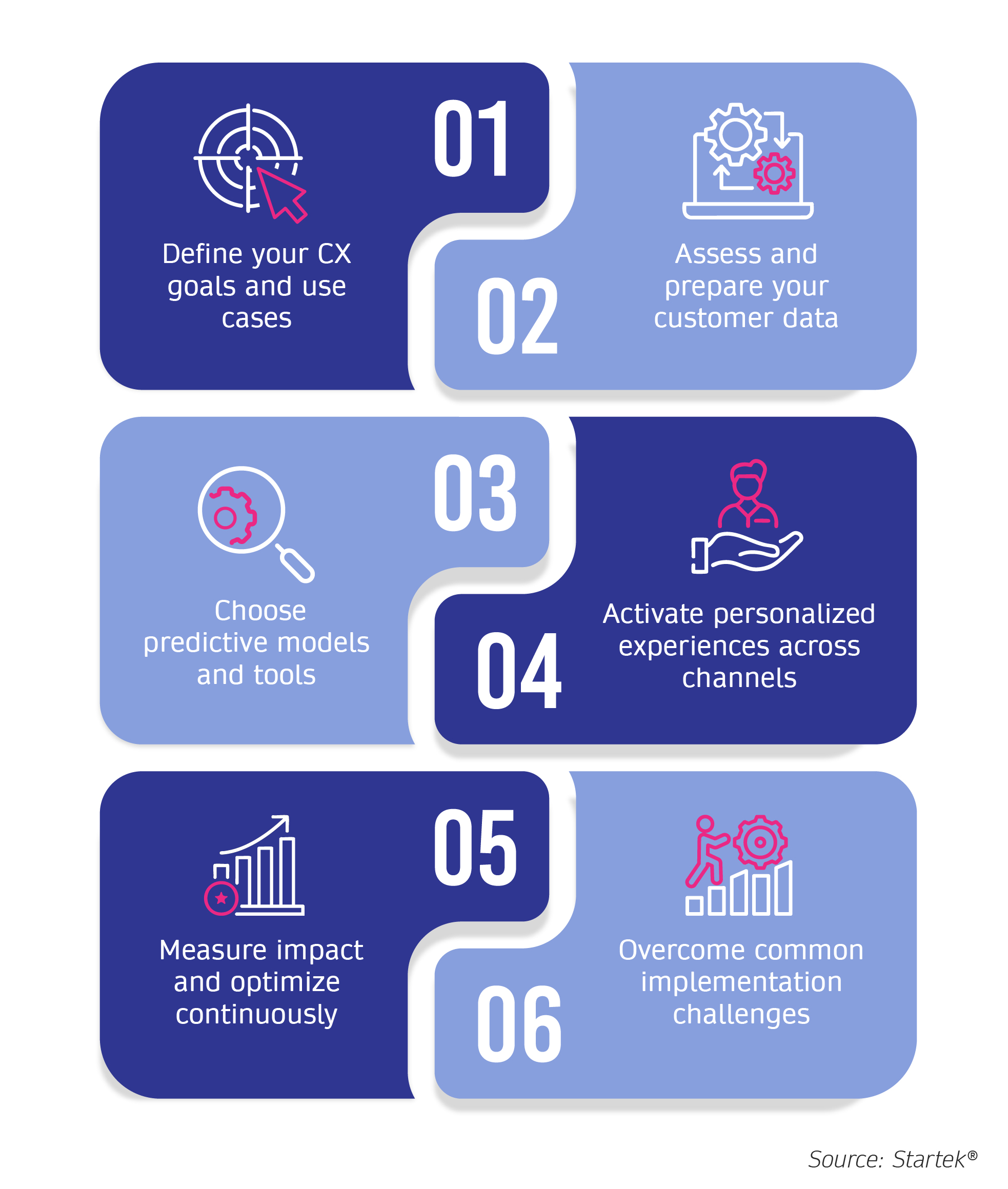
Step 6 - Overcome common implementation challenges

Implementing AI predictive personalization comes with challenges, from fragmented data and legacy systems to skill gaps and change management. Addressing these early is key to scaling successfully. Prioritize data integration, ensure strong governance and invest in digital employee enablement so teams will be able to confidently adopt new tools and workflows. Building an AI-augmented workforce supported by workforce intelligence helps bridge capability gaps, align operations and ensure that personalization efforts are consistent, effective and sustainable across the organization.

Conclusion

With deep expertise in AI predictive personalization, Startek helps enterprises turn strategy into scalable, real-world CX impact. By combining advanced analytics, workforce intelligence and digital employee enablement, Startek enables organizations to deliver proactive, high-value customer experiences at every touchpoint.
Ready to turn predictive insights into real CX impact? Partner with Startek today

Customer Experience Insights

Contact us

Useful links

Manage cookies

Startek All Rights Reserved