


March 24, 2026 | 5 min read
The business impact is significant. Organizations that use AI-powered personalization are improving customer satisfaction, increasing retention and delivering more relevant experiences across every touchpoint by turning customer insights into real-time actions. Rather than relying on broad customer segments or static campaigns, predictive personalization helps brands understand customer intent, recommend the next best action and create seamless journeys that strengthen long-term relationships. According to Medallia’s research, 82% of consumers say personalized experiences influence their choice of brand in at least half of their shopping interactions. Reflecting this growing expectation, Medallia’s 2024 State of CX Personalization Report found that delivering more personalized customer experiences is the top priority for CX leaders.
Delivering personalized recommendations, proactive support and relevant communications makes customers feel understood and valued. This leads to higher satisfaction, stronger brand loyalty and long-term customer relationships.
Predictive insights help businesses present the right offer, product and service at the right time. More relevant interactions increase purchase intent, improve conversion rates and drive higher customer lifetime value.
By anticipating customer needs and streamlining interactions, predictive personalization minimizes the effort required to complete tasks or resolve issues. This creates faster, smoother and more seamless customer journeys.
Identifying behavioral patterns and potential churn risks enables businesses to take proactive action before customers disengage. Personalized engagement strategies strengthen relationships and improve customer retention.
Organizations operationalize predictive personalization by combining data, intelligence and execution to deliver a personalized experience in customer service across every customer interaction at scale.
Organizations consolidate data from multiple touchpoints such as voice, chat, digital and social to create a single, real-time customer view. This unified foundation enables personalized CX by capturing behavioral patterns, preferences and intent signals that shape a more accurate personalized customer experience.
AI for personalized customer experiences analyzes historical and real-time data to identify patterns, predict intent and recommend next-best actions. These insights allow businesses to move beyond reactive engagement and proactively design personalized CX that aligns with evolving customer needs.
Over 95% of customer interactions are expected to be powered by AI, accelerating AI for personalized customer experiences at scale.
Systems activate insights instantly by orchestrating interactions across channels. Whether it’s recommending a product, triggering proactive support and customizing messaging, organizations deliver a personalized customer experience in the moment.
Predictive personalization continuously improves through feedback loops and performance data. AI models refine predictions based on outcomes, enabling organizations to enhance personalized CX over time and deliver increasingly accurate, efficient and impactful personalized customer experiences.
Predictive personalization helps organizations across industries deliver more relevant, seamless and proactive customer experiences by leveraging data-driven insights and AI.
Retailers use predictive personalization to recommend products, tailor promotions and optimize shopping journeys based on customer preferences and browsing behavior, increasing conversions and customer loyalty.
Telecom providers leverage predictive insights to deliver personalized plans, recommend value-added services and proactively address customer issues, improving satisfaction and reducing churn.
Travel and hospitality brands personalize trip recommendations, targeted offers and guest services based on traveler preferences and past interactions, creating more memorable customer experiences.
Financial institutions use predictive personalization to recommend relevant financial products, detect customer needs and provide proactive support while enhancing security and customer trust.
Healthcare organizations leverage predictive personalization to improve patient engagement through personalized wellness recommendations, appointment reminders and tailored care plans, leading to better patient experiences and outcomes.
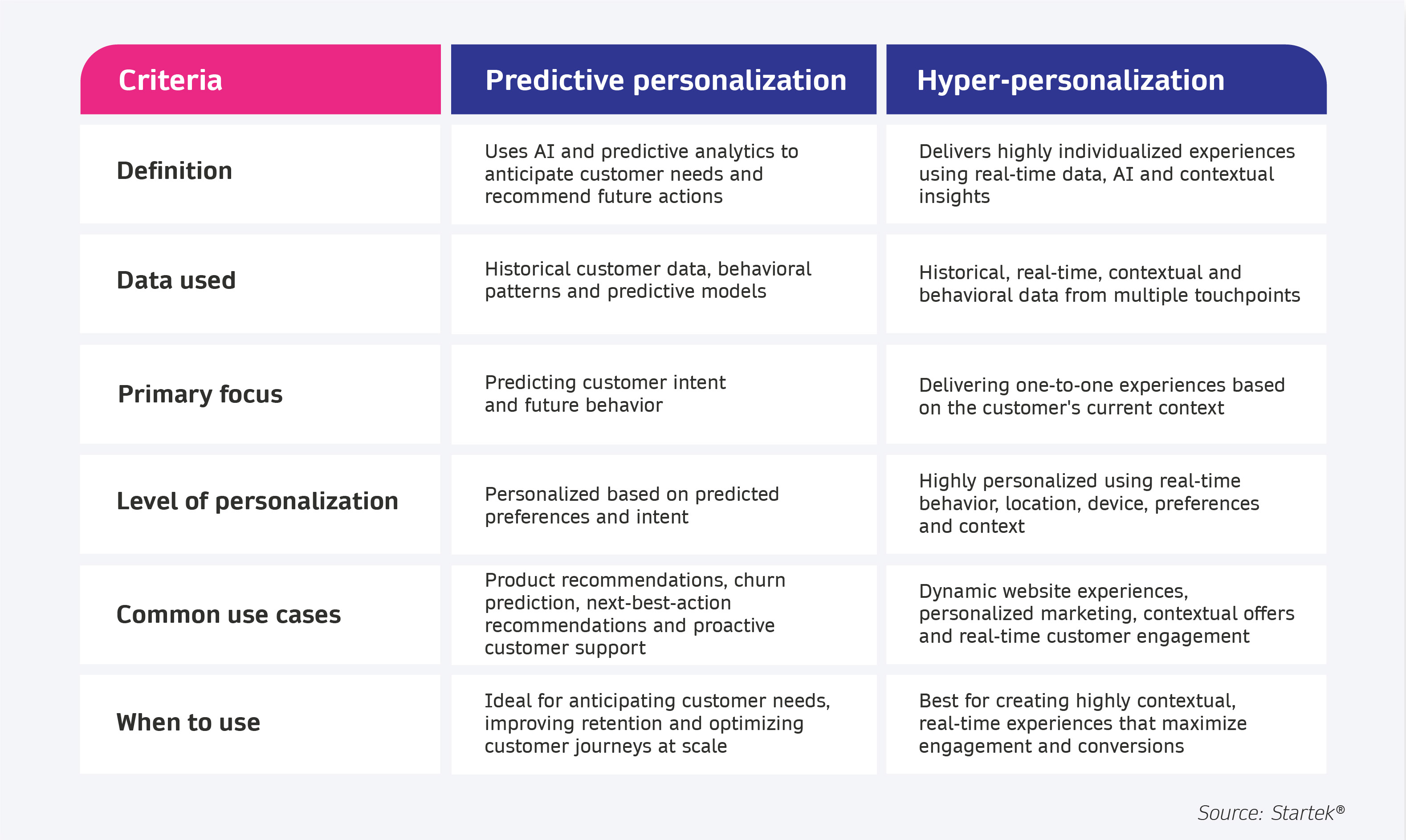
Predictive personalization is reshaping customer experience by enabling businesses to anticipate customer needs and deliver relevant interactions at the right time. Its ability to improve engagement and business outcomes has made it a key CX priority.
AI analyzes customer behavior to recommend relevant products and services, improving engagement and conversions.
Businesses anticipate customer issues and provide proactive, personalized support before problems escalate.
Real-time insights help determine the most relevant action, offer and interaction for each customer.
Customer data enables targeted campaigns that deliver more relevant content and improve marketing performance.
Predictive models identify at-risk customers, allowing businesses to take proactive steps to improve retention.
Digital experiences adapt in real time to display personalized content, recommendations and offers.
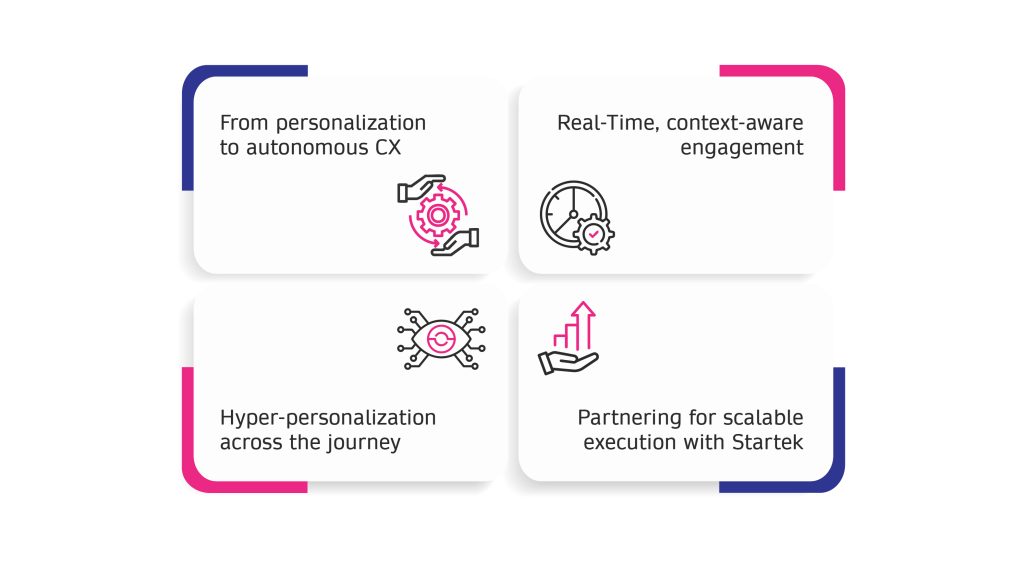
Predictive personalization will continue to shape how enterprises deliver a scalable, high-impact personalized customer experience.
AI for personalized customer experiences will move from recommendations to autonomous actions, enabling real-time, self-optimizing CX with minimal manual intervention.
Organizations will extend predictive personalization across the full lifecycle, delivering a consistent personalized customer experience across every touchpoint.
Businesses will use real-time data and AI to deliver personalized CX that adapts instantly to customer behavior, intent and context.
Startek helps enterprises operationalize AI for personalized customer experiences by combining data, analytics and omnichannel execution, turning predictive personalization into measurable business impact.
Startek All Rights Reserved